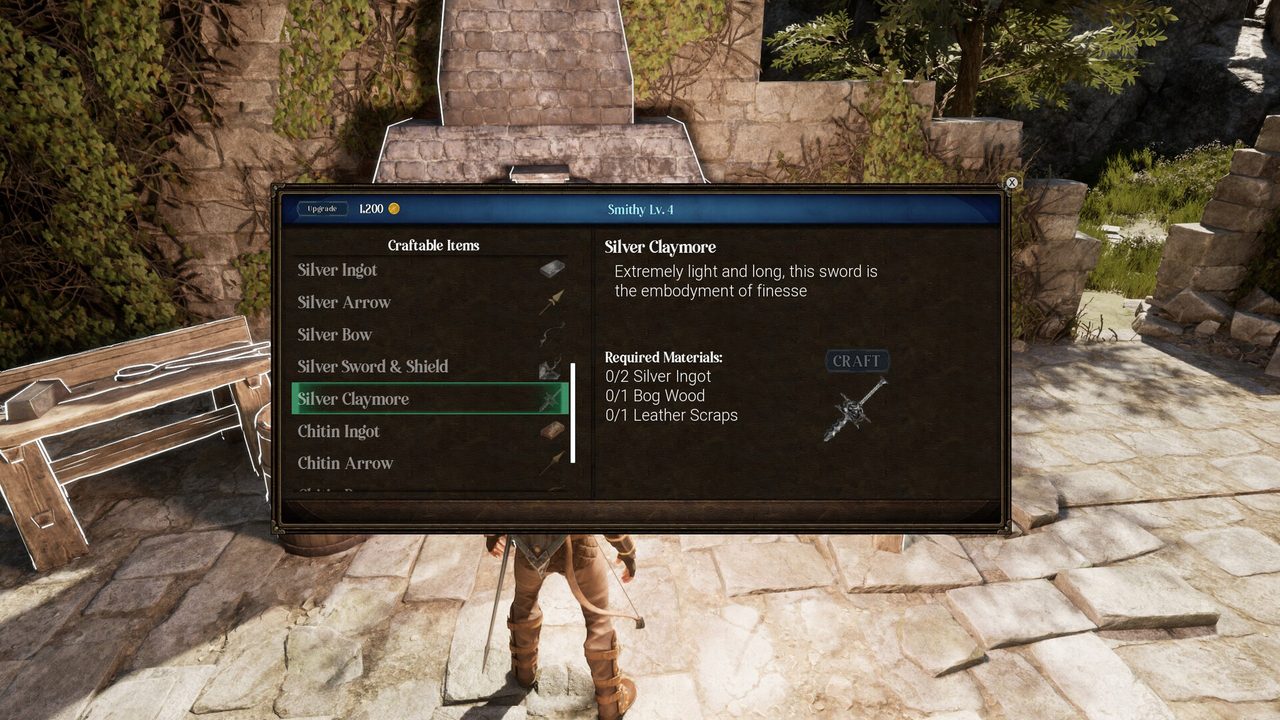
Start with the camp stations, not the crafting menu guesses
The introduction explicitly offers a bedroll, smithy, cooking pot and Soul Forge. This is the main between-run workflow. It makes the most sense to identify each station by purpose before trying to decode individual recipe counts from someone else’s screenshot. Steam’s store description independently confirms that crafting, cooking potions and strengthening your character are core game systems.
The smithy is where recorded gameplay shows weapon crafting and materials such as scraps/ingots. The cooking station shows food and potion crafting, with craft-station upgrades mentioned in a demo tooltip. The Soul Forge is presented as the place to use gold for character attribute improvements, such as health or stamina. The inventory/stash and merchant affect what materials are available or safely kept.
These roles are more durable than the exact recipe list. The screenshots visible online include old image timestamps and demos were adjusted throughout summer 2026. This page therefore treats the station descriptions as demonstrated and leaves numerical recipes, permanent unlock prices and stat formulas unclaimed.
| Station | What it handles | Verify in your build |
|---|---|---|
| Smithy | Weapon and gear crafting from materials such as scraps and ingots | Current recipe list, ingredient counts and upgrade tiers |
| Cooking pot | Food and potion crafting for runs | Ingredient availability, effect values and stack limits |
| Soul Forge | Gold spent on character attributes — health, stamina and combat stats | Attribute list, costs and any caps |
| Merchant / stash | Buying, selling and storing materials between runs | What persists, prices and expansion options |
- Identify the station needed for your objective: gear, healing or attributes.
- Read its current material requirements before spending.
- Check which crafting inputs are in your stash or on your character.
- Choose the change that addresses your last run’s obstacle.
Do not copy numbers visible in a dated screenshot into a September retail recipe guide.
Crafting at the smithy: equipment first
The recorded smithy menu contains weapons and materials, and one player compares sword-and-shield equipment with a spear while considering reach. That gives a useful practical framework: select a weapon you can operate reliably rather than purchasing an unfamiliar option solely because it appears higher on an old demo list.
If your problem is losing trades with ordinary enemies, a weapon with comfortable timing can matter more than small unknown stat differences. If ranged combat lets you approach a risky group more safely, check how the current build equips and supplies it. Avoid committing all materials to a recipe you have not confirmed is available.
A crafting interface screenshot can illustrate where the smithy is, but it cannot prove present-day values or that every beta item exists in the release. The site keeps no invented recipe table: exact ingredient counts require verified September menu captures, item names, version and confirmation of whether station upgrades alter availability.
- Open the smithy and inspect only currently visible recipes.
- Separate ingredients you can gather now from materials requiring deeper runs.
- Craft an upgrade only when you can explain the problem it solves.
- Check the resulting item in the equipment screen before descending.
No recipe planner is published: current-version ingredient counts are not verified yet, and a wrong planner is worse than none.
Cooking, potions and preparation
The cooking pot is demonstrated in multiple demo playthroughs, including food and a potion. Video tooltips describe upgrading crafting stations with gold to unlock further options, though those menu details can change. For a first run, you are better served by learning which provisions you can actually prepare than assuming a community build’s ingredient cost remains valid.
Before leaving camp, check the consumables currently in your inventory and your ability to use them during combat. There is a meaningful difference between owning an ingredient, having a recipe unlocked and carrying a finished consumable. The run loop punishes entering a new fight while expecting the wrong item to be ready.
Plan a simple before-run routine: decide on one meal or potion objective, inspect its current recipe, verify your available materials, craft it if possible and confirm it is equipped or accessible. That procedure works even if patch notes change an ingredient. We do not publish exact HP-restoration values or duration figures without an observed retail truth source.
- Choose your next desired provision and inspect its live recipe.
- Check whether you have ingredients in the correct inventory or stash.
- Craft and confirm the output before entering the ruins.
- Keep a fallback extraction plan when you run short of consumables.
The 16 September playtest notes are not proof of identical retail crafting behavior.
Soul Forge and merchant: spend to fix your bottleneck
A recorded tutorial explains that the Soul Forge spends gold on Alric’s attributes. A player opens a menu with health, intelligence, ranged and melee improvements, stamina and strength. We can document the existence of that upgrade loop without declaring an optimal build, a precise point cap or the value of a particular stat across all weapons.
Use the cause of your last defeat as a guide. If you consistently run out of stamina before dodging, look at the stamina options currently offered. If you survive the approach but cannot finish fights, inspect equipment and attack timing before making a blind attribute purchase. If you cannot afford a purchase yet, prioritise extracting a modest haul instead of gambling every run on a boss.
The merchant and stash should be understood as parts of the resources flow; exact inventory rules, prices and which items persist must be verified against the playable retail build. Treat any saved player spreadsheet or screenshot as versioned, not as timeless fact.
- After returning, identify what actually ended or slowed the run.
- Check current Soul Forge upgrade choices and their costs.
- Compare a survivability upgrade with a crafting purchase.
- Keep a short record of the result on your next run.
A “best build” calculator would be fake precision without current stat coefficients and costs.
Week 2–3 changes at camp and in the inventory
v1.08 (3 October) rebuilt the potion bar: there are now three quickslots, bound to keys 1, 2 and 3 by default on keyboard, with a D-pad selection wheel on controller. Food can be slotted alongside potions, and the inventory window was rebuilt around the new slots.
v1.09 (4 October) raised the camp overworld's colour saturation — the developer called it a little washed out — and v1.11 (8 October) added two more save slots plus Steam Cloud saves, so camp can now hold separate runs for separate build experiments.
All three changes are post-launch (v1.08, v1.09, v1.11); demo footage and launch-week notes predate them.
Week 4 (16 October): amulets at camp, and the announced Infusion system
Amulets are now part of the camp routine: each one takes its own inventory slot, and v1.11 (8 October) fixed a bug where moving an amulet into the stash with the Stash Item buttons stripped its rarity and perks and left a regular amulet behind. If an old stash transfer appeared to downgrade an amulet, that was the bug — the transfer itself is fixed since v1.11.
The announced next camp-facing system is Infusion. In the developer's plan, Infusion Cores with randomized stats will be found in the dungeon, carried back to camp and infused onto your gear, with traits described as deeper than plain stat buffs. It is announced, not live — no current build has it.
Amulets are live now; Infusion is confirmed as part of one larger update (with armor sets) planned before the end of 2026 — a plan, not a shipped feature.
v1.12 (17 October): station and menu fixes
The 17 October v1.12 patch fixes two camp-facing problems: crafting stations can no longer be levelled above their maximum level, and upgraded stations no longer lose their models. It also clears an overlap in the Soul Forge menu, where the price could sit on top of the Upgrade button.
The same patch added a cooldown to the kick attack — a combat change the developer says will make more sense once the Infusion system in the previous chapter arrives.
v1.12 is a fixes-only patch (17 October 2026); the Infusion and armor-set update is still upcoming.
Original sources and limitations
Compare footage with your game build. The links below provide context, not proof that the retail version shares every demo rule.